Purchasing is growing; integration into daily practice much less so. Usability friction, the quality of selected models and shadow AI widen the gap between the prescribed tool and the tool people find useful.
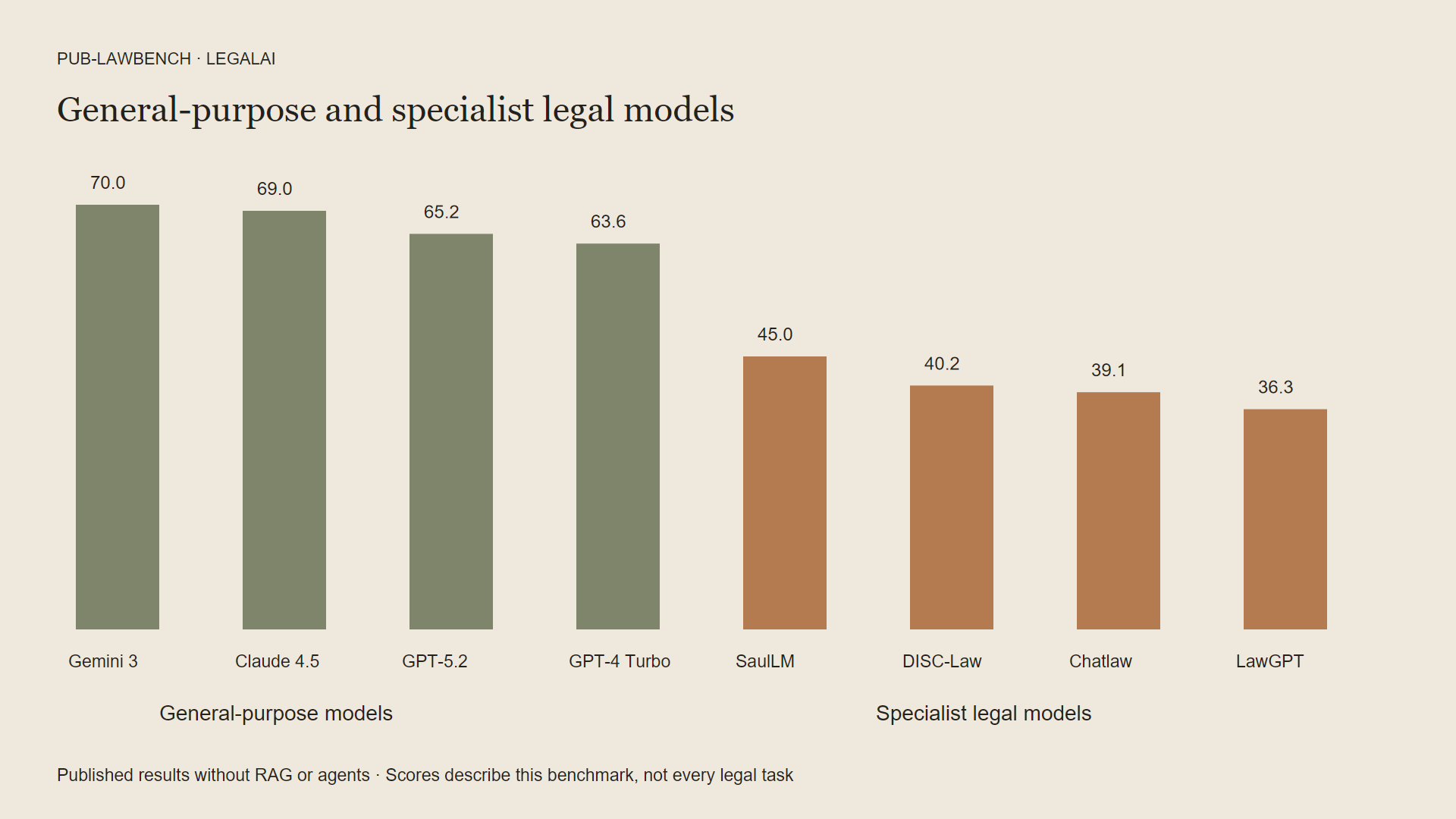
Pub-LawBench · LegalAI — scores compared without RAG or agents. Lexanon visualisation based on published results.
Legal AI adoption grows when a real task becomes easier without sacrificing quality or data control. Licence numbers are not enough: measure the complete workflow, including preparation and review.
The spread of legal AI remains largely nominal. Budgets are allocated, licences accumulate and announcements promise transformation. Within actual matters, the shift remains rare.
According to the 2026 report fromAxiom
surveying 528 in-house legal leaders, only
7 % of legal departments have deployed AI across their organisation. Meanwhile, 83 % have no formal measure of the effectiveness of their spending. Purchasing is progressing, but governance and actual use struggle to keep up.
What holds back everyday adoption
Several factors reinforce each other. The first concerns the working environment: moving from familiar document handling—files, exhibits, annotations and spreadsheets—to a conversational interface or agent workflow is a break with established practice. It involves more than training; it changes how people engage with legal material.
There are also practical frictions: transferring and then recontextualising documents, format or length constraints, and lost consistency when a matter is split into successive prompts. The prescribed tool often requires preparation that consumer tools bypass—at the expense of professional secrecy.
A less discussed variable completes the picture:
the quality of the foundation model chosen by the publisher. A specialised interface is not enough if its underlying engine trails frontier models.
When legal specialisation is not enough
Pub-LawBench
evaluated 17 models on public-facing legal tasks without RAG or agents—in other words, under conditions close to what a non-expert professional can obtain from a chat. Commercial general-purpose models scored between 63.6 and 71.8, compared with 36.3 to 45.0
for the four legally specialised models tested (SaulLM, DISC-Law, ChatLaw, LawGPT).
The benchmark is not a controlled experiment on specialisation: models differ in size, generation and training conditions. It nevertheless offers a useful snapshot of available products: legal specialisation does not necessarily compensate for a capability gap with frontier models.
Domain specialisation is not enough if the foundation model trails general capabilities available elsewhere.
The implication for firms and legal departments is direct. A “legal” tool may be more reassuring in marketing or contractual terms while producing less useful responses than a recent general-purpose model—provided that model can be used without exposing identifying case data.
Deployment, professional secrecy and available models
Part of this gap also reflects deployment conditions. In France, requirements concerning professional secrecy, data transfers, hosting and potential access by foreign authorities lead some publishers to favour locally hostable models or versions already approved within a restricted scope.
The CNIL
notes that European hosting does not always neutralise risks arising from extraterritorial laws applying to the provider. These precautions are legally understandable, but they narrow the models immediately available in “compliant” products.
The resulting paradox is that the more governance restricts institutional offerings, the wider the gap with capabilities professionals see—and use—outside the prescribed framework.
Shadow AI is not just a discipline problem
The gap between the prescribed tool and the one actually considered useful encourages workarounds. Thomson Reuters' report
Future of Professionals 2026
finds that 34 % of professionals use AI tools not approved by their organisation. That proportion reaches 41 % among those who believe their organisation is adopting AI too slowly. At the same time,
41 % say they lack access to professional tools meeting their requirements, particularly confidential data protection and grounding in verifiable content.
Shadow AI cannot therefore be reduced to poor internal discipline. It reflects a mismatch between prescribed uses and tools professionals find capable and easy enough to use. Banning them without providing a useful alternative does not close the risk; it moves it beyond visibility.
Separate data protection from model choice
One response is to separate data protection from model choice. When compliance requires a fixed, often weaker engine, the organisation buys reassurance at the expense of performance. Conversely, letting professionals paste raw documents into consumer chats maximises apparent performance at the expense of secrecy.
Lexanon takes the opposite approach: pseudonymisation runs locally on the computer; the chosen model receives only a version stripped of direct identifiers. Governance then focuses on the information disclosed without permanently imposing a particular foundation model. Claude, GPT, Gemini or Mistral may evolve; control over what leaves the file remains local.
Lexanon AI interface: the professional keeps the choice of model, using documents already pseudonymised locally.
This architecture does not by itself solve measurement gaps or change management. It does address the tension driving shadow AI: an artificial opposition between performance and compliance. While professionals must choose between a prescribed tool they find inadequate and a capable one they consider risky, adoption will remain nominal and workarounds structural.
The issue is therefore more than “adopting AI”: it is making the model capabilities practitioners already consider necessary usable within the bounds of professional secrecy.
A practical pilot for legal AI adoption
Start with a narrow task: produce an initial document summary, prepare a letter outline or compare wording. Define an acceptable result before starting. A smooth experience does not replace checking facts, references and omissions. The output remains working material subject to professional judgement.
Measure the entire workflow
Record file preparation, response and correction time. Compare the total with the usual method on similarly difficult tasks. Also record abandoned attempts: someone returning to their old tool provides useful evidence about the new workflow's burden or limits. A pilot must be able to conclude that a use offers no gain.
Define an understandable framework
Specify authorised documents, data recipients and who approves the result. Distinguish local analysis from remote provider calls. Service settings, access rights and retention rules must be understood before use. Pseudonymisation is a preparation step; it does not replace this assessment.
Turn feedback into decisions
After the pilot, decide for each task whether to continue, adjust or stop. Explain the decision with examples of acceptable results and errors. Training can then address real situations rather than an abstract feature list. Recheck the workflow whenever a model or tool changes.
In Lexanon, documents are prepared locally before use with a chosen integration. This separation allows two distinct questions: which information may be disclosed, and which model actually helps complete the task? A good answer to the second does not automatically resolve the first.
To distinguish pseudonymisation from anonymisation, see the CNIL factsheet and the GDPR, Article 4(5) and Recital 26. These references explain data processing; they do not certify any product.
This article provides general information and is not personalised legal advice. Checks must be adapted to the matter and its recipient.
Practical questions
What are the barriers to legal AI adoption?
Legal AI adoption depends on usefulness in real work, response quality and ease of use. Document preparation, access and confidentiality rules can add constraints. A pilot focused on one task helps identify these difficulties before deployment.
How should a law firm start an AI pilot?
Choose a frequent task with a verifiable result, then prepare examples and success criteria. Include preparation and review time in the comparison. Define authorised data, responsible people and stopping conditions before measuring potential gains.
Does pseudonymisation authorise every use of AI?
No. Pseudonymisation reduces some directly identifying information but does not remove every risk. Context may still allow identification. The firm must assess the recipient, service terms and content actually disclosed, including questions and attachments.
Which metric should you track after buying licences?
Licence numbers measure equipment, not usefulness. Track completed and verified tasks, total time spent on the matter, corrections and abandoned attempts. Also collect users' difficulties. These measures distinguish lasting benefits from an impressive demonstration.